Oscillation and Its Applications
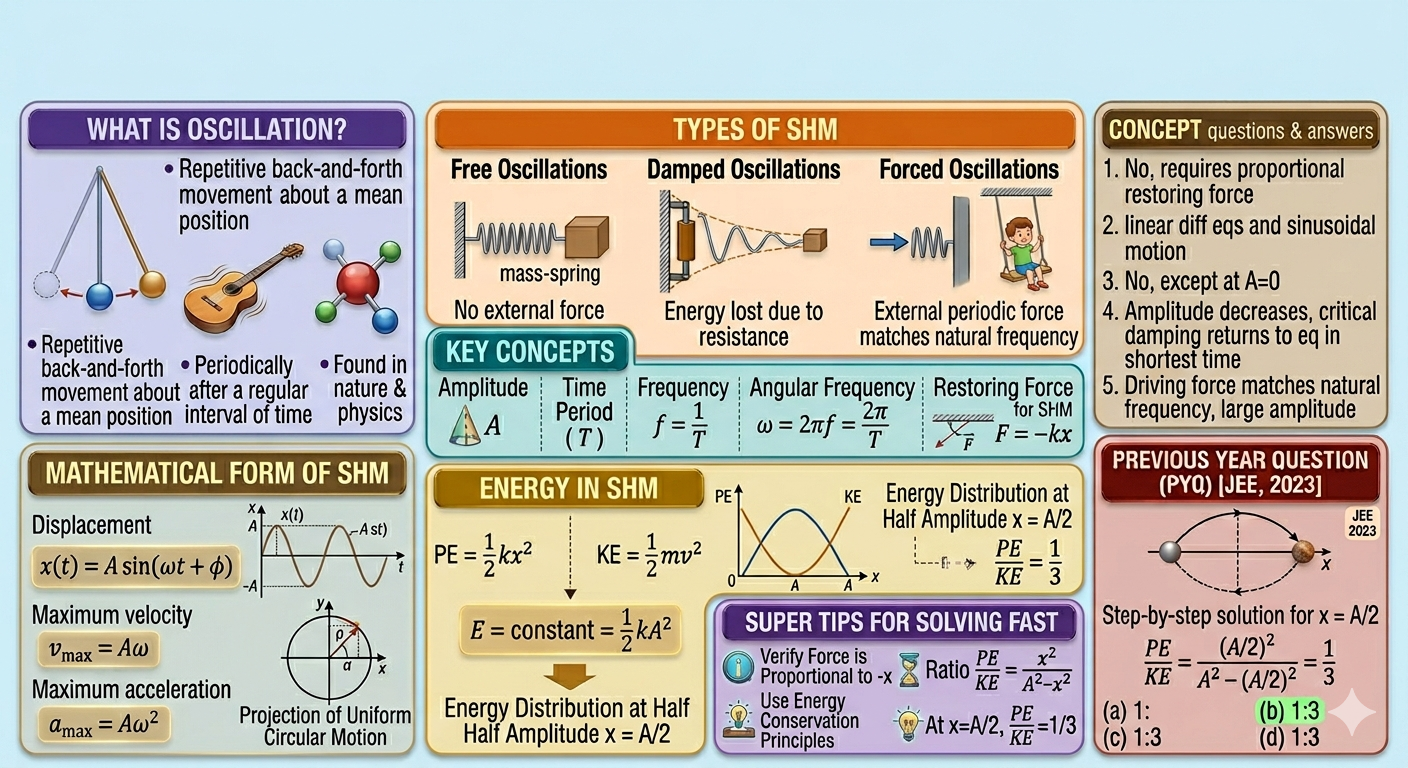
Image generated by Google AI
What Is Oscillation?
Imagine gently pushing a swing in a playground. You pull it back, release it, and it glides forward, slows down, comes back, and repeats the motion again and again. That simple, almost hypnotic motion is one of the most fundamental patterns in physics—oscillation. Once you start noticing it, you will realize it’s everywhere.
Oscillation refers to the repetitive back-and-forth movement of a system about a mean position. It's a common phenomenon found in nature and physics, from the swinging of a pendulum to the vibrations of a guitar string or atoms in a molecule. The key characteristic of oscillatory motion is that it is periodic, meaning it repeats itself after a regular interval of time.
What makes oscillations especially fascinating is that completely different systems, mechanical, electrical, even biological, can behave in strikingly similar ways. Oscillatory systems can be mechanical (like a mass on a spring), electrical (like LC circuits), or even biological (like heartbeats). In fact, oscillations also appear in chemical reactions, population dynamics in ecology, and even in financial markets, making them a universal concept across disciplines. Understanding oscillations helps us grasp the principles of how systems evolve over time and respond to various forces.
At a deeper level, oscillations often arise whenever a system has two competing tendencies: one that pulls it away from equilibrium and another that tries to restore it. This interplay between inertia and restoring influence is the essence of oscillatory motion.
Types of Oscillations
Oscillations are broadly categorized into the following types:
- Free Oscillations: These occur when a system is displaced from its equilibrium position and allowed to move without any external force or damping. A classic example is an ideal mass-spring system oscillating freely after being pulled and released.
- Damped Oscillations: In real systems, resistive forces like friction cause oscillations to lose energy over time, so their amplitude gradually decreases. For instance, shock absorbers in vehicles use damping to reduce unwanted vibrations. Eventually, if energy loss continues, the oscillations stop completely.
- Forced Oscillations: These arise when an external periodic force drives the system. If the driving frequency matches the system's natural frequency, a phenomenon called resonance occurs, resulting in large amplitude oscillations that can sometimes cause damage.
- Simple Harmonic Motion (SHM): This is a special case of oscillation where the restoring force is directly proportional to displacement and acts in the opposite direction. SHM is the fundamental type, as it models many physical systems and forms the basis for understanding more complex oscillatory behaviors.
In such systems, the total energy remains constant, and the system “remembers” its natural frequency, this is like the system’s own signature rhythm.
Interestingly, damping doesn’t just reduce motion, it changes how the system behaves. Depending on the strength of damping, the system can oscillate slowly, quickly die out, or not oscillate at all.
This is why bridges, buildings, and even machines must be carefully designed, to avoid resonance conditions that can amplify motion dangerously.
Think of SHM as the “purest form” of oscillation, like a perfect note in music. Real systems may deviate, but SHM provides the foundation to understand them.
Key Concepts and Definitions
- Amplitude (A): The maximum displacement of the system from its mean (equilibrium) position.
- Time Period (T): The time taken to complete one full oscillation cycle.
- Frequency (f): The number of oscillations occurring in one second. It is the reciprocal of the period:
This essentially tells us how “far” the system stretches during motion, larger amplitude means more energy stored in the system.
- Angular Frequency (\( \omega \)): Related to frequency by:
Angular frequency gives a more natural description when dealing with circular motion and sinusoidal functions, which is why it appears frequently in SHM equations.
- Phase: This term describes the state of oscillation (the position and direction of motion) at a particular instant in time. It helps specify exactly where in its cycle the system is.
- Restoring Force: A force that always acts to bring the system back to its equilibrium. In SHM, it follows Hooke’s law:
Two particles can have the same amplitude and frequency but still behave differently if their phases differ, this is crucial in wave interference phenomena.
where \( k \) is the force constant and \( x \) is the displacement. The negative sign shows the force opposes displacement, pulling the system back toward the center.
This negative sign is more than just a symbol, it encodes stability. Without it, the system would accelerate away instead of returning.
Mathematical Form of SHM
The displacement \( x(t) \) of a particle undergoing SHM is described by the equation:
Here:
- \( x(t) \) is the displacement at time \( t \)
- \( A \) is the amplitude, or maximum displacement
- \( \omega \) is the angular frequency
- \( \phi \) is the phase constant, which sets the initial condition of the motion
This equation shows that the particle’s position varies smoothly and periodically over time. The phase constant \( \phi \) is especially useful when the oscillation does not start from the equilibrium position.
One subtle but powerful insight: this equation is mathematically identical to the projection of circular motion. If you imagine a point moving uniformly in a circle, its shadow on a diameter performs SHM.
Velocity and acceleration, which are the first and second derivatives of displacement with respect to time, are:
Notice the negative sign in acceleration indicates that it always points toward the mean position, confirming the restoring nature of the force driving the oscillation.
Also observe: acceleration is directly proportional to displacement but opposite in direction, this is the defining condition for SHM.
Energy in Simple Harmonic Motion
In ideal SHM, total mechanical energy remains constant because energy keeps shifting between kinetic and potential forms without loss.
- Potential Energy (PE): Stored energy due to displacement
- Kinetic Energy (KE): Energy due to motion
- Total Energy (E): Sum of kinetic and potential energy
Thus, the system’s energy continuously oscillates between kinetic and potential forms, but their sum remains unchanged throughout the motion. This conservation holds true assuming no damping or external forces act on the system.
An interesting observation: at the mean position, all energy is kinetic, while at extreme positions, all energy is potential. This continuous exchange is what sustains motion.
Shortcut Concepts
- SHM can be visualized as the projection of uniform circular motion onto one dimension.
- Displacement, velocity, and acceleration vary sinusoidally with time.
- Maximum speed is:
- Maximum acceleration is:
- The time taken for the particle to move from mean position to extreme position is one-quarter of the time period:
A useful trick: whenever motion involves symmetry (like SHM), time intervals can often be broken into equal fractions like \( T/4 \), \( T/2 \), etc.
Examples
- Mass-Spring System: A block of mass \( m \) attached to a spring with spring constant \( k \) executes SHM. Its time period is:
This formula shows how mass and spring stiffness affect the speed of oscillation.
Heavier masses oscillate more slowly, while stiffer springs (larger \( k \)) make the system oscillate faster.
- Simple Pendulum: A bob of mass \( m \) suspended from a string of length \( L \) swings back and forth. For small angular displacements, the motion approximates SHM with time period:
where \( g \) is acceleration due to gravity.
Notice something subtle: mass does not appear in the formula. This means all pendulums of the same length oscillate with the same period, regardless of mass.
- Energy Distribution at Half Amplitude: When displacement is \( x = \frac{A}{2} \), potential energy is:
Kinetic energy is the remainder of total energy:
So the ratio of potential to kinetic energy is:
Concept Questions with Explanations
- Is SHM possible without a restoring force?
No. SHM fundamentally requires a restoring force proportional and opposite to displacement, otherwise the system won’t oscillate periodically. - Why is SHM considered the simplest form of oscillation?
Because it is described by linear differential equations leading to sinusoidal motion, making it mathematically tractable. More complex oscillations involve nonlinearities. - Can total energy in SHM ever be zero?
Only if the amplitude is zero, meaning no motion occurs. Otherwise, the total mechanical energy remains constant and positive. - What happens when damping is introduced?
The amplitude decreases gradually over time as energy is lost, eventually stopping oscillations. In critical damping, the system returns to equilibrium without oscillating, in the shortest possible time. - What is resonance?
Resonance happens when the frequency of an external driving force matches the natural frequency of the system, causing oscillations of very large amplitude.
A deeper takeaway: most real-world failures due to oscillations (like structural collapse) are not because of motion itself, but because of uncontrolled resonance.
Super Tips for Solving Fast
- Always verify if the force is proportional to the negative of displacement to confirm SHM behavior.
- Use energy conservation principles when solving problems involving velocities or positions.
- The ratio of potential to kinetic energy at any displacement \( x \) is:
- At half amplitude, \( x = \frac{A}{2} \), the ratio simplifies to:
Keep this ratio formula in mind, it’s extremely powerful and appears frequently in exams.
Previous Year Questions (PYQs)
Q1.
A particle is executing simple harmonic motion. The ratio of potential energy and kinetic energy of the particle when its displacement is half of its amplitude will be:
[JEE Main, 2023]
- 2:1
- 1:3
- 1:4
- 1:1
Solution:
When \( x = \frac{A}{2} \), use the energy ratio formula:
Answer: \( \boxed{1:3} \)
This is a classic example where remembering the general ratio formula can save time and avoid lengthy calculations.