Projectile Motion: Concept, Equations, and Shortcuts
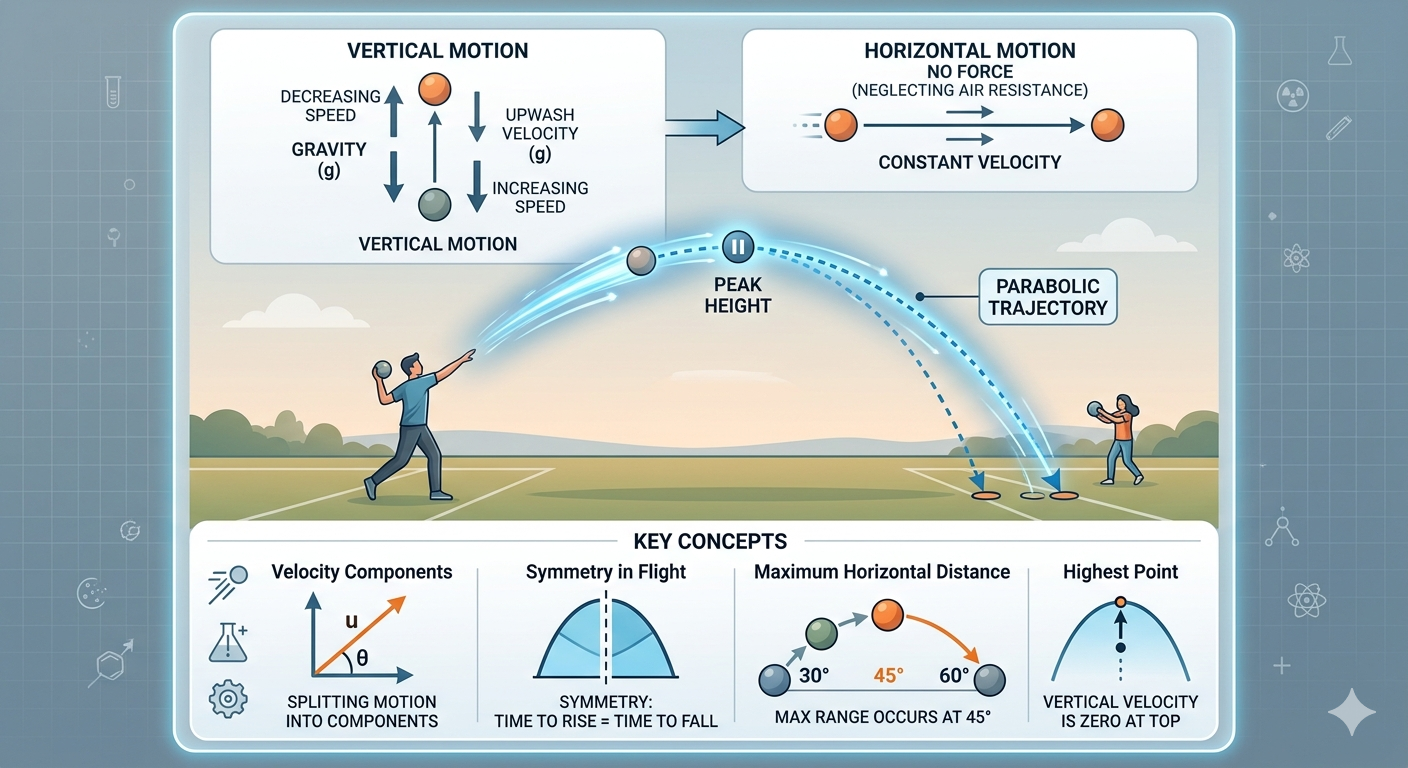
Image generated by Google AI
What Is Projectile Motion?
Think about the last time you tossed a ball to a friend, kicked a football, or even watched water arc out of a fountain. There is something oddly satisfying about that curved path, right? It rises, slows down, pauses for a split second, and then falls back down. It almost feels intentional, like the object “knows” where to go.
But here is the fascinating part: that entire motion follows a very precise set of physical laws. What looks like a casual throw is actually a perfect demonstration of physics in action.
Projectile motion refers to the motion of an object that is thrown or projected into the air and is subject only to acceleration due to gravity. It is a two-dimensional motion in which the object moves along a curved trajectory known as a parabola.
If you observe carefully, every such motion, whether it's a cricket ball, a basketball shot, or even a stone you throw, traces this same parabolic shape. That is not a coincidence. It is a direct consequence of how gravity acts.
The only force acting on the object (after projection) is gravity, which acts vertically downward. The horizontal and vertical motions are treated separately and analyzed using the equations of motion.
This separation is one of the smartest tricks in physics. In reality, motion is happening all at once, but by splitting it into horizontal and vertical parts, we make a complex problem beautifully simple. Horizontally, nothing interferes. Vertically, gravity takes over completely. And together, they create that elegant curve you see.
Key Equations
If a particle is projected with an initial velocity \( u \) at an angle \( \theta \) from the horizontal:
Let us build this step by step, just like you would think about it in real life. When you throw something at an angle, part of your effort goes into pushing it forward, and part goes into lifting it upward.
- Initial velocity components:
These components tell us exactly how much of the velocity is doing what. The horizontal part keeps the object moving forward steadily, while the vertical part fights against gravity.
- Time of Flight:
Notice something subtle here: the time of flight depends only on the vertical component \( u \sin \theta \). No matter how fast you throw something horizontally, it won’t stay in the air longer unless you throw it upward more strongly.
- Maximum Height:
This comes from the idea that as the object rises, its vertical velocity decreases until it becomes zero at the top. All that upward motion energy gets “used up” against gravity.
- Horizontal Range:
This equation hides a beautiful symmetry. Angles like 30° and 60° give the same range. So if you throw a ball shallow or steep, but with complementary angles, it lands at the same distance.
- Equation of Trajectory:
This equation mathematically describes that curved path you see. The first term tries to make the motion straight, while the second term (because of gravity) bends it downward, creating a parabola.
Shortcut Concepts
- Horizontal velocity remains constant throughout motion.
- Vertical motion is uniformly accelerated motion (acceleration = \( -g \)).
- At the highest point, vertical velocity is zero.
- Maximum range occurs when \( \theta = 45^\circ \).
- Time to reach maximum height = \( \frac{T}{2} \).
Let us connect these to intuition:
- Since no force acts horizontally, nothing changes that motion, so it stays constant.
- Gravity keeps pulling downward the entire time, which is why vertical motion is uniformly accelerated.
- At the top, the object “pauses” vertically for an instant before coming down, that is where vertical velocity becomes zero.
- The 45° angle gives the perfect balance between height and distance.
- The motion is symmetric, so going up takes the same time as coming down.
Examples
- A projectile is fired with \( u = 20\,\text{m/s} \) at \( \theta = 30^\circ \):
Let us interpret what is happening, not just calculate.
The object stays in the air for 2 seconds, this is controlled entirely by how much upward velocity it has.
It reaches only 5 meters high, because most of the velocity is directed forward rather than upward.
So it travels quite far horizontally, that is the trade-off between height and range.
- A stone is thrown horizontally from a height of 80 m with speed 10 m/s.
This situation feels different because there is no initial upward motion.
Time to hit ground:
Here is something surprising: the time depends only on height, not on horizontal speed.
Horizontal distance covered:
The horizontal motion simply continues at constant speed while gravity decides how long the motion lasts.
Concept Questions with Explanations
- Is the horizontal acceleration zero in projectile motion?
Yes, no force acts horizontally (neglecting air resistance). - What is the shape of the projectile path?
A parabola due to quadratic dependence of vertical displacement on horizontal distance. - At what point is vertical velocity zero?
At the highest point of the trajectory. - Can two angles give the same range?
Yes, angles \( \theta \) and \( 90^\circ - \theta \) yield same range if projected with same speed. - What affects time of flight most?
Vertical component of velocity \( (u \sin \theta) \).
Each of these ideas comes directly from how gravity influences only one direction of motion.
Super Tips for Solving Fast
- Use symmetry: time to rise = time to fall.
- Horizontal motion: \( x = u_x t \); vertical motion: use kinematic equations.
- Always resolve velocity into components before applying formulas.
- Range is maximum when \( \theta = 45^\circ \).
In exams, the faster you recognize the pattern, the easier everything becomes. The moment you see a projectile, split it into horizontal and vertical parts, that is half the problem solved already.
Previous Year Questions (PYQs)
Q1.
A bullet is fired from a gun at the speed of \( 280\,\text{m/s} \) in the direction \( 30^\circ \) above the horizontal. The maximum height attained by the bullet is:
(NEET 2023)
Given: \( g = 9.8\,\text{m/s}^2, \sin 30^\circ = 0.5 \)
- 2000 m
- 1000 m
- 3000 m
- 2800 m
Solution:
Answer: \( \boxed{1000 \, \text{m}} \)
Once you understand the concept, this becomes a one-line problem instead of a long calculation.