Uniform Circular Motion: Concept, Equations, and Shortcuts
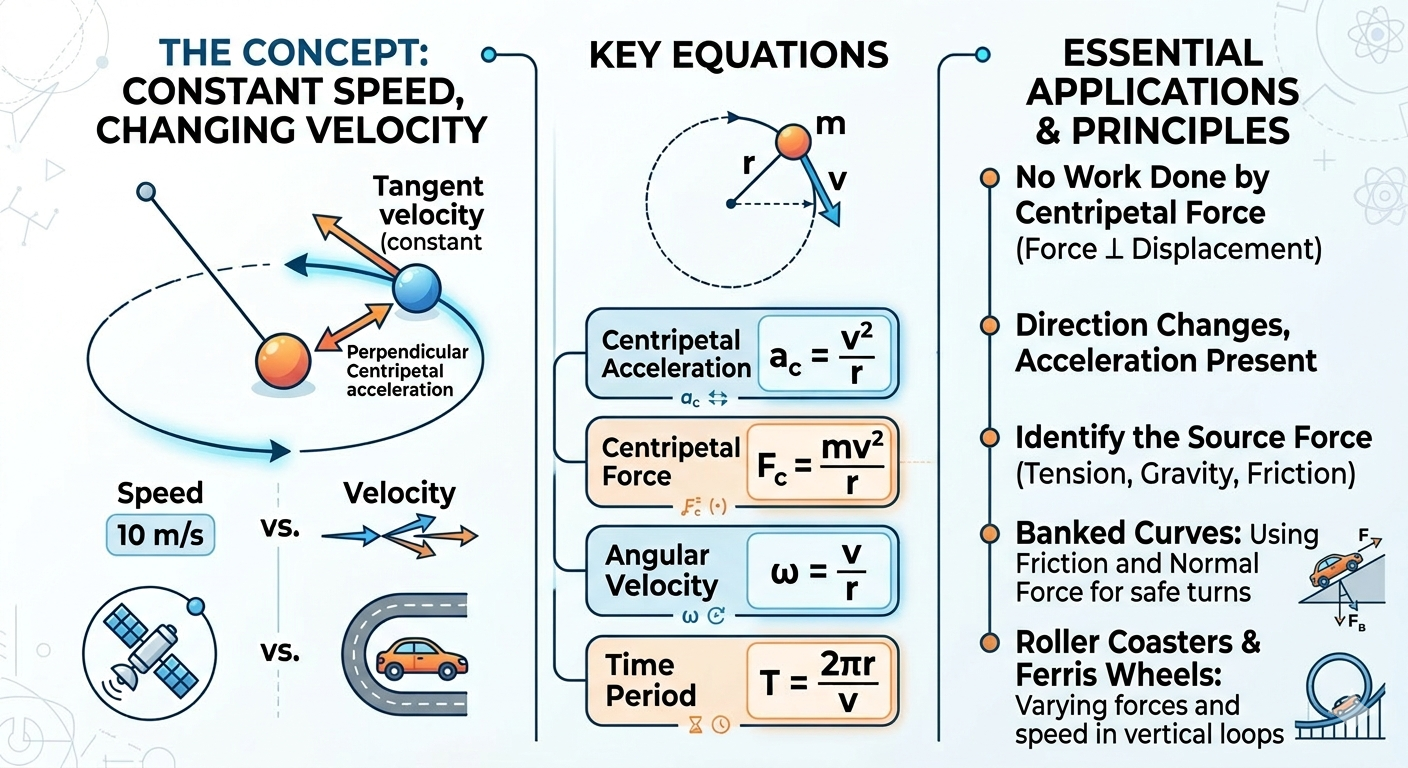
Image generated by Google AI
What Is Uniform Circular Motion?
Imagine you are sitting and watching a ceiling fan. It keeps spinning smoothly, round and round, never speeding up or slowing down. At first glance, it feels like nothing is changing, but look a little closer, and there is a beautiful piece of physics unfolding right in front of you.
Uniform Circular Motion (UCM) refers to the motion of an object traveling at constant speed along a circular path. Although the speed remains constant, the direction of the velocity continuously changes, meaning the object is accelerating. This acceleration is called centripetal acceleration, and it always points toward the center of the circular path.
Now pause and think about that for a second, even when something is moving at a steady speed, it can still be accelerating, just because it's direction is changing. That is the heart of UCM.
Such motion is common in daily life, examples include a satellite orbiting Earth, a fan blade spinning, or a car turning in a circular track. UCM is an example of two-dimensional motion with constant magnitude of velocity but changing direction.
Key Equations
Once you understand the idea, the equations start to feel less like formulas to memorize and more like tools to describe what is really happening.
For a body of mass \( m \) moving in a circle of radius \( r \) with constant speed \( v \):
- Centripetal Acceleration:
\[ a_c = \frac{v^2}{r} \]
This tells you how strongly the object is being “pulled” toward the center. Faster speed or a tighter circle means stronger inward acceleration.
- Centripetal Force:
\[ F_c = m a_c = \frac{mv^2}{r} \]
Force is simply mass times acceleration. This is not a new type of force, it is just the net inward force required to keep the object moving in a circle.
- Angular Velocity:
\[ \omega = \frac{v}{r} \]
Instead of thinking in straight-line speed, angular velocity tells you how quickly the object sweeps out angles.
- Relation Between Linear and Angular Quantities:
\[ v = r \omega, \quad a_c = r \omega^2 \]
These are your bridges, they connect straight-line motion with rotational motion.
- Time Period and Frequency:
\[ T = \frac{2\pi r}{v}, \quad f = \frac{1}{T} = \frac{\omega}{2\pi} \]
Time period tells you how long one full round takes, while frequency tells you how many rounds happen every second.
Shortcut Concepts
If you are revising quickly before an exam, these are the ideas you want to keep flashing in your mind:
- Speed is constant, but velocity is not (due to changing direction).
- Acceleration is always directed toward the center (centripetal).
- No work is done by centripetal force (force is perpendicular to displacement).
- Angular velocity remains constant in UCM.
- Frequency is the number of revolutions per second.
A quick mental image helps: velocity is always tangential, acceleration is always radial (inward). Keep those directions clear, and half your confusion disappears.
Examples
Let us slow down and walk through a couple of problems together, just like you would in a classroom.
-
A stone tied to a string of length 2 m is whirled in a horizontal circle with speed 4 m/s. Find centripetal force if the mass is 0.5 kg.
Here, everything is already given, you just need to plug into the formula. Think of it as translating the physical situation into math:
\[ F_c = \frac{mv^2}{r} = \frac{0.5 \cdot 16}{2} = 4\,\text{N} \]So the string must be pulling with a force of 4 N to keep the stone moving in a circle.
-
A car moves in a circle of radius 10 m with angular speed \( 2\,\text{rad/s} \). Find linear speed and centripetal acceleration.
Start by converting angular motion into linear motion:
\[ v = r \omega = 10 \cdot 2 = 20\,\text{m/s} \]Now use that speed to find acceleration:
\[ a_c = \frac{v^2}{r} = \frac{400}{10} = 40\,\text{m/s}^2 \]Notice how everything flows step by step—first velocity, then acceleration.
Concept Questions with Explanations
These are the kinds of questions that test whether you really understand what is going on, not just whether you can use formulas.
-
Is there acceleration in UCM?
Yes, even though speed is constant, direction changes continuously, resulting in centripetal acceleration.Think of it this way: if velocity changes, acceleration must exist—no exceptions.
-
Is centripetal force a separate force?
No, it is the net inward force (like tension, gravity, or friction) that causes circular motion.It is not a new force, it is just a role played by existing forces.
-
Can work be done in UCM?
No, since force is perpendicular to displacement, no work is done.Energy stays constant, which is why speed does not change.
-
What provides centripetal force in planetary motion?
Gravitational force acts as the centripetal force.Gravity keeps planets locked in their paths.
-
What happens if centripetal force is removed?
The object will move tangentially to the circle due to inertia.It “escapes” the circle instantly and moves in a straight line.
Super Tips for Solving Fast
When time is short, clarity matters more than anything else. Keep these in mind:
- Remember: Centripetal acceleration \( a = \frac{v^2}{r} \) and not zero.
- For angular motion, use \( v = r\omega \) and \( a = r\omega^2 \).
- Always identify what provides the centripetal force (tension, gravity, friction).
- Time period is total time for one complete circle: \( T = \frac{2\pi r}{v} \).
If you stay clear about directions and formulas, most problems become straightforward.
Previous Year Questions (PYQs)
Q1.
Two particles A and B are moving in uniform circular motion in concentric circles of radii \( r_A \) and \( r_B \) with speeds \( v_A \) and \( v_B \) respectively. Their time periods of rotation are the same. The ratio of angular speed of A to that of B will be:
(NEET 2019)
(a) \( v_A : v_B \)
(b) \( 1 : 1 \)
(c) \( r_B : r_A \)
(d) \( r_A : r_B \)
Solution:
Let us not rush, just follow the logic carefully.
Given:
- Particles A and B perform uniform circular motion.
- They move in concentric circles with radii \( r_A \) and \( r_B \), and linear speeds \( v_A \) and \( v_B \).
- Their time periods are equal, i.e., \( T_A = T_B = T \).
Start from a familiar relation:
Applying this to A and B:
Now shift to angular speed:
So,
Both simplify to the same value, that is the key observation.
Answer: \( \boxed{1 : 1} \)